
[00:00:00] Hi, I'm Chrissy Mack from Radio Northern Beaches and you've just tuned in to the Listen and Chat with Chrissy Mack podcast. This is the space where we pull no punches, sometimes a little controversial, sometimes downright outrageous and sometimes just packed full of information that is interesting to know. Listeners, this morning I have on the phone with me Dr Becht from Sydney Animal Hospital and we're going to be talking about bird proofing your yard.
[00:00:27] There is so much out there that we don't understand and Dr Becht is here to give us the facts and get rid of the fiction. So welcome to Radio Northern Beaches, Dr Becht. Thanks, Chrissy. Lovely to be here. There's lots of misinformation, there's lots of fear out in society at the moment about this bird flu and possibly rightly so because it's happened so suddenly and as we know it's the last country to get this.
[00:00:55] And we know we've had so much devastation through our animal population with floods and fires and now we've got this and you know we're worried about our wildlife as well as our pets. So let's start with how bird flu has actually spread and who it spreads to and what it spreads to. Absolutely. Christine, I think that part of the reason why we've been sort of the last affected and we've sort of got all of these case studies of other countries and other continents
[00:01:24] that have already gone through this process is that predominantly we see a major reservoir of the virus in our migratory seabirds. So obviously we're a fair way from anywhere so it does take a while for those sorts of things to filter to us down under. And so we see it spread predominantly through those reservoirs and some of those birds display clinical signs but many of them actually don't have any clinical signs.
[00:01:50] And so we see that virus spread around the world because these birds can carry huge distances. And so we've seen really that kind of spread that way. Now this particular strain of bird flu, the difficulty with this is that it can affect a really wide variety of species. And so containing it's very difficult. It's spread predominantly through close contact, so immediate contact between birds or animals.
[00:02:19] But it can also be spread through sort of respiratory secretions. So for example, you imagine if you have a flu and you've got all snotty and sneezy, those sorts of things happen to animals and birds as well. So those sorts of secretions as well as in the poo can carry the virus and infect other animals. And then the other thing that we see is spread via fomites, which is essentially where we're having contact with contaminated either your hands,
[00:02:46] your clothes, equipment, those sorts of things can spread those virus particles as well. Okay. And this virus, it's quite a hardy virus. So it survives in the environment outside an animal for quite some time when it's cold and wet. So that really facilitates this spread throughout multiple populations and multiple environments as well. All right. So how do we as pet owners, people that have wildlife around our houses,
[00:03:15] because I live in Cromer on the northern beaches, and we have a lot of wild birds within our yards. We love them. We look after our birds as best we can, especially when there's drought. How do we protect our own animals, our backyard animals, because we have locally chickens in the backyard. We've got cats. We've got dogs, pet birds. How do we yard proof?
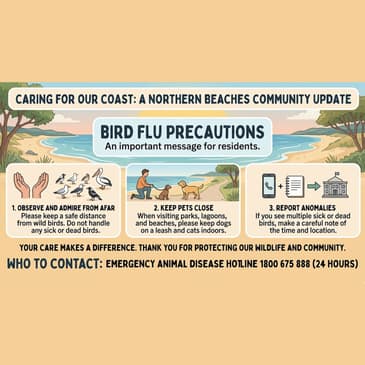
[00:03:38] I think one thing that I'll stress before we get into yard proofing is, you know, we want to take care of our wild birds and our local populations. But it's important that we don't feed them at this stage. So if we have lots of birds in a small space, which is if you're feeding them and you get a lot of them coming at once, that's going to increase potential spread. So I would certainly recommend against feeding wild birds. There's lots of food out there for them. They can get it themselves.
[00:04:07] And, you know, that will allow them not to have to be in really high density locations. Well, that's really good advice. And I, yeah, for people who feed the birds, please don't right now. Yeah. I know you feel like you're doing a good thing, but it's something that if we don't want to attract them all together at once, we want them to practice social distancing in birds. Yes, we've done that as humans. Now we need to let the birds do it. As I said, you're on the northern beaches. We have an abundance of bird life.
[00:04:37] So how do we deal with that? So if you have, you know, backyard chickens or you've got pet birds, they're probably the highest risk. So at this point, we'd probably recommend against, you know, your free roam type scenario at this stage. We really want to try and limit their contact with wild birds. So making sure that their enclosures are secure with a fine mesh and making sure that there's a solid covering over the top
[00:05:01] so that any birds coming over the top aren't able to pass sort of faecal material or particles down into their enclosure. And then also making sure that we practice really good hygiene, so cleaning their water and food sources really regularly. I'd certainly recommend that the water sources that we're using for our pet birds, you know, make sure they're a sort of a chlorinated source. So out of our taps is fine, but try and avoid getting it, you know, from dams and those sorts of things,
[00:05:30] because we could have potential contaminants there as well. And then also just making sure that we're keeping all of the food stock that you've got for your birds well contained, so in sealed containers so that you can't have any access by wild birds as well. So for our chickens and our pet birds, that's probably the way to go at this stage. We really want to try and limit the contact. And if we have been out walking in wetlands or lake areas,
[00:05:57] anywhere that we could have sort of walked through, you know, sort of muddy, cold, muddy areas, I'd certainly also recommend making sure you change your footwear and your clothes before you go and interact with your pet birds when you get home. So what risk is there to our cats and our dogs? We know that this virus, as I said before, it has a wide variety of species that it can infect, and cats and dogs are not immune to that.
[00:06:24] They are much more resistant than most of our bird species, which is good. We know that cats have a little bit more potential for infection, whether that's because they're inherently more at risk or because they're just more likely to be hunters of those infected birds. I don't think it's particularly clear, but either way, making sure, ideally keeping your cats inside or essentially, you know, supervised in the backyard
[00:06:51] so that they can't interact with those wild birds and can't hunt as well is going to help to protect them from this virus. Well, that's good advice also. So what effect do you think it's going to have on the suburban areas? It seems to be spreading really quickly. How do you see that happening into the suburban areas and throughout the country? I mean, I think, you know, luckily our dogs don't seem to be at a massive risk.
[00:07:20] I think as long as we keep them on leash when we go for walks through the environment and particularly in those waterway areas so that they can't scavenge any, you know, carcasses of wild birds is going to protect them fairly well. Unfortunately, I think it's something that we can expect it to progress a little bit over the course of the next few months. And how that will end up looking, I don't think we know yet. There was a case with a fox that was infected.
[00:07:48] I believe that was in South Australia recently. So we know that its progression to mammals is certainly happening. And I think it's something that we don't know yet how this is going to end up. I mean, luckily, we do have very good biosecurity protocols within Australia. So hopefully that will help to protect our commercial populations, of which we've seen really significant economic impacts overseas with problems with that.
[00:08:17] But I think, you know, as much as we can, we need to try and limit contact, you know, between the birds because the ecological impact is difficult to predict. As we have mass dying events, which we've had in the past from various reasons, as you said, bushfires, floods. But it does really impact the genetic diversity that we see in our wild populations and our wildlife.
[00:08:42] So as much as possible to try and adhere to these rules to give our wild populations the best chance. Okay. Now, we know that the birds, certain birds can be vaccinated, especially the species that are endangered. How close are we to the mammal vaccinations? And there's obviously no alert or no vaccination for your pets either, I gather. No, so there's no vaccine available at this stage for mammals. I don't know.
[00:09:12] I'm not familiar with whether that's even really in end-stage production or anything like that. The avian vaccine is being used and that's being rolled out throughout some of our protected species. You know, the zoos and CSIRO are working very closely to try and get that across for a lot of the species that we know are critically endangered. But the difficulty of the vaccine is that it needs to be given in two doses a month apart.
[00:09:40] And so you can imagine trying to get a migratory seabird to say, well, look, would you mind just coming back to Sydney for us in a month for your second vaccine? It's very difficult. Yeah. Logistically, it's really going to be limited to those captive populations or populations where they are located in one spot for, you know, a significant length of time. So from that perspective, it is a difficult undertaking.
[00:10:06] And, you know, I don't envy the guys trying to make that work because it is going to be a difficult thing to have, you know, as an effective measure. Hopefully, if we can at least protect some of the very at-risk species, you know, it will give us at least a little bit of herd immunity for some of the bird populations and retain some genetic diversity. Look, this may be something that we are overreacting
[00:10:33] and it might be something that seems to settle once we get into the warmer months. But I think it's definitely better to be safe rather than sorry and try and prepare as much as possible. Okay. So you said some birds don't show symptoms, but they obviously spread the disease. Are those birds affected or do they just recover? So it can vary. So the clinical signs can vary from no clinical signs and then the bird is otherwise well
[00:11:00] through to nasal discharge, anything you expect to have from a flu. We can see that in the birds. Fatigue, lethargy, weight loss, and then sudden death with no other clinical signs is also possible. So there's a very large spectrum of clinical signs with this particular virus. And I think that's also part of the difficulty because the virus has potential to be spread for some time
[00:11:26] with sick birds or birds that don't actually have any clinical signs. So it's difficult to get a hold of. Okay. So remind us again if we find a dead bird in our backyard or as we're walking, the process that we need to go through. Yeah. So if we find a dead bird or a sick bird, something that you think doesn't look quite right, it's important to notify. There's a hotline on the agriculture website, the DPI website.
[00:11:57] 1-800-675-888. And the website is? There's a couple that you can look at, but www.agriculture.gov.au. So it's important to give that line a buzz, notify them of the location, what the bird looks like, and the time. And then it's because I think at this point we're still really in that information gathering stage.
[00:12:21] So we need more information about how this is spreading, where it's spreading to, and what species are affected. So make sure we notify the hotline. Every sick or dead bird is not necessarily a bird flu case. You know, there are lots of other things that can happen, unfortunately, that cause birds to get into a bit of strife. But we do want to make sure that we notify.
[00:12:49] And then, you know, the authorities will either send out a collection crew, or they may say, no, this is very low risk, leave it be. Or they will give you further direction on how to dispose of it. Okay. All right, a question I haven't asked is, if bird flu gets into our area, what sort of symptoms would we be watching out for in our cats and dogs and our own birds?
[00:13:13] Yeah, so for the birds, you know, really any changes in their ocular discharge or nasal discharge. So if they have a runny nose, if their breathing seems really labored, that kind of stuff. The other thing that we might see is changing colour to the wattles and combs. So the big red fleshy bits on their heads that we see with chickens. If those sorts of things seem to get a little bit darker or purpler, or any kind of bruising around the head and face. They're probably the main ones that we might see with our chickens.
[00:13:43] And then for cats and dogs, you know, we're really looking at lethargy, respiratory signs. So cough, sneeze, runny nose, runny eyes. You know, and generally they will be off their food as well. So any of those sorts of things where we're seeing any kind of flu-like symptoms, or if they just seem that they're really not themselves and really tired and not wanting to eat very much, would be the things to look for in our pets. Okay. Now, we seem to have a COVID toilet paper rush in reverse.
[00:14:12] We've got people not buying chicken or eggs because of the scare of the bird flu. Now, we need to set people straight about this. Absolutely. Absolutely. So, you know, we don't have any evidence of any spread into our commercial poultry population in Australia. And, you know, we are lucky that there are very strict biosecurity measures for a lot of our poultry operations as well. And a lot of strict testing as well during the processing.
[00:14:41] So it's something that is certainly on the lookout, but it's not been noted yet. And hopefully it won't ever be. But even if it were to be in some of the chicken meat, you know, cooking the virus will kill it. So, you know, making sure that we are handling chicken and all that sort of stuff appropriately. So making sure we wash our hands, keep it separate from fresh vegetables and other things, and making sure we're cooking it appropriately.
[00:15:07] And really the virus essentially dies at about 74 degrees Celsius. And that's really something that we would be meeting with general cooking of the chicken to a point where it's not pink anymore. So luckily that the virus does tend to die at those hotter temperatures. And so the risk of buying chicken is certainly not there. And I would encourage everybody to continue buying chicken and eggs and poultry products as you have been.
[00:15:36] But certainly the risk is not there. And, you know, it's something that we want to try and support, you know, those sorts of sectors of our agriculture as well. By getting frightened and not buying chicken and eggs, you're hurting our farmers. And our farmers are in need right now. So you can test your chicken by putting a thermostat in and making sure that the centre of the chicken is 74 degrees, which is 165 Fahrenheit for those who are still using Fahrenheit.
[00:16:02] So as long as you cook everything well, as you said, wash your hands. Don't put cooked meat on a plate that you've had raw meat on. Make sure that's all washed. Don't put it back on a board that you've had raw meat on. Just the common sense stuff. It gets rid of the risk altogether. Absolutely. All the same stuff that we would usually do for normal chicken stuff, you know, salmonella and things like that. It's all the same. So pretty much keeping doing what you're doing. Okay.
[00:16:29] So if a dog or a cat brings a bird home and puts it in the garden or at your feet, which cats are known to do, so do you need to take them straight to the vet, the bird and the cat? Or how do you deal with that? I mean, I think, you know, certainly the type of bird makes a bit of a difference. If the dog or cat has brought home a migratory seabird, then it would be something probably to give your vet a call and check in. You know, that can be quite helpful.
[00:16:57] And I would also, the hotline that we were talking about, I would also certainly alert them. And I would monitor quite closely for any clinical signs in our pets. Now, the other thing that we need to know how to do is to actually dispose of these adequately, because obviously if they bring it home and dump it on your living room floor, you're not going to leave that there. And so making sure that we protect ourselves appropriately as we dispose of these. And, you know, giving the agriculture hotline a call will help with this.
[00:17:25] So they will give you instructions. But making sure that you've got some rubber gloves at home and potentially even a plastic apron and a couple of thick plastic bags are going to be the way to dispose of the carcass. Okay. Now, on the news, there's been this big ruckus about the council, one of the councils not cleaning up one of their wharves or walkout areas onto the water. And, you know, people are seeing all this bird poo all over the place.
[00:17:53] And they're saying, oh, well, you know, it's not a danger to humans or whatever. But is it a danger to birds that land on it? It is, yeah. And that's why we certainly recommend making sure all of our pet birds and, you know, things like that are contained. Look, I think it's a very difficult task to clean up all the bird poo in the world, right? You know, that's a little bit unrealistic.
[00:18:18] And so I think really the thing to focus on is making sure that we're not feeding birds, particularly in that location where we know that there's a lot of fecal droppings and there is potential for, you know, a more condensed transmission in that location. So it would be something that I think is a difficult thing to clean every area where birds do a lot of poos. You know, but if we can minimize their return to that location, that's probably the best option.
[00:18:46] Well, the reason I was asking that question is on the northern beaches, as I said, we have a lot of birds. And we have some birds, and especially cockatoos, who like to sit on our garden furniture or on our veranda rails and poop. So obviously we need to be wearing gloves when we're cleaning that up. Do we need to use a disinfectant or what do we need? Yeah, disinfectants are really useful. So probably the main one I would look for is called F10.
[00:19:13] That's certainly registered for use with this virus particle. But there are a few other options available, also a list on the agriculture website as well. But F10 would be the preferred one that we would use in the clinic, and that is available as well. Okay. Well, we addressed bird baths and making sure they were all clean, etc. Was there anything else we should be aware of? I think really it's just making sure that we're, you know, sort of taking the steps,
[00:19:41] notifying if we're seeing birds, and making sure that we're still buying chicken and eggs and poultry products. You know, I think it's important that we make sure that we support this sector and make sure that you keep an eye out on the news and keep up to date with the progression of this, because it is changing quickly. And the recommendations over the coming weeks to months may change in accordance with that. Eggs are a very valuable source of vitamin C.
[00:20:08] So you shouldn't take them out of your diet. They're also delicious. That's right. Well, Dr. Beck, thank you so much for talking to us. That's a lot of information to take in. And we'll do our best to keep an eye and report what's happening in our area. Absolutely. That's the most important thing we can do at this stage. Thank you again so much for talking to us. Thank you. All right. I hope I've given you a lot to think about and talk about and debate and maybe disagree with.
[00:20:38] Don't forget to follow, like and share. Stay safe and I'll catch you next time.