
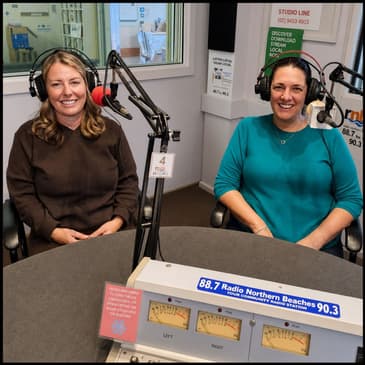
[00:00:00] Hi, I'm Chrissy Mack from Radio Northern Beaches and you've just tuned in to the Listen and Chat with Chrissy Mack podcast. This is the space where we pull no punches, sometimes a little controversial, sometimes downright outrageous and sometimes just packed full of information that is interesting to know. Today listeners, we have in the studio with us Kerry Gleeson from the Kerry Gleeson Centre who has been here before and we have a guest with her also, Jodie Anderson,
[00:00:29] who is also a volunteer but well they'll tell you all about that shortly. Now I'm not going to go into a lot of what Kerry is all about because she's been here before and we had an interview with her, she'll sort of brush over what's been happening since our interview. And so I'm going to welcome Kerry and Jodie to Radio Northern Beaches. Welcome both of you. Amazing. Thank you so much Christine for having us back. We had such a great response to our last segment and we had quite a few people reaching out offering to help.
[00:00:58] So I really appreciate you sharing the news of our charity and we've got lots of updates. But before we go on to that, I'd love to hand over to Jodie for a bit. She's the gem behind the centre. She's my rock. She's the one that's really kind of brought this to fruition and made this happen. So I'd love to hand over to her to just kind of introduce herself. Hi everyone. Thanks for having me today.
[00:01:22] I'm a volunteer for Kerry and I've been working behind the scenes since around January to get us charity approved. And now it's very exciting because we've, since March, we've been working at the Tram Shed every Tuesday night and holding beautiful space for our community members to come and visit us. And yeah, but we do need more volunteers. So it'd be good to have extra hand because at the moment it's Kerry and I doing all the work and we're really reaching people.
[00:01:50] And it'd be great to have more people to come and work with us and help the community. So Jodie, what do you do and what would you like other volunteers to be involved in? Well, I do a lot of the administration behind the scenes and get flyers up and running and let everyone know about the events and we get them on socials. Doing grants. Right now we're trying to get money to keep us going every Tuesday night and get sponsors behind us.
[00:02:18] So as far as volunteers are concerned, we're looking for, we've also got a masquerade event coming up in October. So we need lots of volunteers to help us on Tuesday nights. We have cuppa and connection with people, also with the masquerade ball, helping get that out to everyone and sell seats for that. And also helping on the night and just getting sponsorships and raffles together. So the night's an amazing night. That's going to be a lot of fun.
[00:02:45] We haven't had a masquerade ball on the Northern Beaches forever. Kerry, tell us a bit about that because that sounds really exciting. Yeah, we are so excited, Christine. I think, as I shared with you previously, I think for myself, having struggled for so long and having felt that I wore a mask all my life and felt that I couldn't really let people see how much I was struggling until recently.
[00:03:10] And I know that a lot of people I work with feel that they do need to wear a mask and that they can't be their true selves. And people are not feeling seen and they're not feeling heard by whether that's their family, their friends, their employees. So this we decided to wear a mask and come as you are. And if you want to keep your mask on for the night, then that's absolutely fine.
[00:03:31] But knowing that if you remove the mask and you take it off, that there is no judgment and that all is welcome, however you are and however you show up. And if that's in tears or happiness and in joy, but just to surrender and be seen as your true self and know that you're welcome as that in the space of the masquerade. So either take it off or keep it on, but all is welcome. So there's a challenge, everybody.
[00:03:55] I'm really excited, actually, even for myself, you know, to go with my mask, but take it off and to have the light shining on all of us in all of our mental health. However we come, however we show up. We've chosen for the ball to be on Mental Health Day, which is the 10th of October. And it's to raise awareness and to raise funds. As Jodie mentioned, we are running our Mind Matters weekly community groups on Tuesday evenings in Lakeview Room in the Tram Shed from 6.30.
[00:04:25] It's a space for community to come together like a drop-in centre on a Tuesday. We run grief groups, as Jodie mentioned, cuppa and connection. So anyone that just wants a cuppa and connection, just come and join us. We do regulating your nervous system kind of well-being groups. We do sounds, we do breath. It's community-led, which we mentioned before. So whatever the community needs, we're here to provide that for them. Last week we did a weekly community group with live music.
[00:04:55] And it was sponsored by Tilly Lane Tees, where we just, everyone came together, had a cuppa and listened to live music. And talked about the power of music and the power of song words and how we can express ourselves through that channel as well. It doesn't always need to be professional therapy. So that was really great. But Jodie and I are running these ourselves. And we're running them, you know, we're paying for the venue. We're paying for tea, coffee. And I'm probably not very good at asking for help.
[00:05:21] But I guess the reason why I've asked to kind of come on here and approach you, Christine, is to really call on the community and ask if we can come together as a collective to really make this work. You know, having worked in the field for so long and seeing the struggle still now, you know, people still coming to us and struggling and feeling failed and feeling like they've fallen through the system somehow. And we're there to kind of hold space, pick up the pieces and offer hope.
[00:05:47] And we thought we can actually do that on the larger scale from getting them to come to our groups. You know, it was amazing. Our first grief group, we had like 20 people, which is awesome. But we need help because there's two of us on the ground working 100 hours a week voluntary. And we just really need, we've kind of put it out on socials, but we really need help. Help to, you know, run our community groups, help to spread awareness, help to put it out on socials.
[00:06:12] And for our event, you know, just we're really looking for sponsorship from any business that can afford any small amount of help on the night just to help cover, you know, some basic costs. We've got an amazing band that's contributing and they're giving it free. So we're looking, you know, to help get money together to pay for their meals on the night. We need like a security guard. We need table decorations. We need insurance.
[00:06:36] We've literally haven't got a penny in the bank, but we are seeing the great results from our Mind Matters weekly community groups. And as we explained before, vision is to have our centre on the beaches and a goal to work towards that. But it's evidence-based. We are empowering people to want to stay, but also to provide tools and strategies earlier on before they get to that point of that real deep struggle. But we just need help.
[00:07:03] So calling on the community to help in any way you can. There's a lot more of it out there at the moment because with the cost of living crisis, more and more people are diving into that really basic area. And, you know, when you're used to being able to look after yourself and care for yourself and make sure you've got a roof over your head and all of a sudden that's threatened, it has the most incredible impact, doesn't it? Absolutely. Yeah. I think too, Christine, we're trying to create a movement here.
[00:07:33] We're not like any other charity that's on the northern beaches or around. We're trying to reach the gaps where people don't meet criterias and we're really there to help them and create this movement, which there's no barriers. So no age restrictions. If they financially have no money, they can still come along and we welcome them. And that's just unheard of. So we're really, yeah, we're really creating a movement. So tell me a little bit about the people who are coming.
[00:08:02] Obviously, I don't want to know details. Just the feelings they're getting and how they're feeling. You know, often with some of the groups that have, you know, they walk in the door, they're as stiff as a board. They don't know whether they're comfortable there or not. How easy are you seeing them enter their comfort zone when they come into your groups? Oh, it's really heartwarming, Christine.
[00:08:23] And yeah, I can see Jodie even smiling now because we leave every week like with a big, you know, full cup and a very warm heart because we make it that it's not difficult. And like Jodie said, there's no eligibility. There's no barriers. There's no age. And there's no registration. You know, sometimes if someone is really in the deep of the struggle to have to register, you know, do a registration for a community group. You kind of, it's a bit of a barrier. It puts you off. It is, yeah.
[00:08:51] You don't want to go in and tell everybody who you are. Especially on your first one. You want to suss out whether the group will suit you or whether you're going to be comfortable with it or whether you just want to walk in and walk out again. That first entry has got to be one of the hardest things anyone can do. Yeah, so I feel what we're really good at is, you know, when someone is feeling anxious and they walk into a space not knowing what they're going to expect or who the other people are, it can be overwhelming.
[00:09:19] So it's, we've kind of done it so it's not bright. You walk in and it's all kind of candles lit and it's a real welcoming space. You know, we have music playing, we have tea. And again, there's no registration, but it's really been productive in terms of people have come to try, for example, the breathwork session, which transformative breathwork is really, really good. It's really good for just shifting, you know, anything like anxiety or trauma.
[00:09:49] It has to be done in a safe space with practitioners that kind of do know what they're doing. And we had, I think the first time we had about 15 and we had like three or four men who were crying and sharing and opening. And it was just, a lot of them said that they would have never tried it. Firstly, if it wasn't free or if it wasn't available, they've never felt the need to do it before. And they did it and they felt lighter and they felt good.
[00:10:15] And we then connected their men with each other, which was really powerful. We've had people come into the grief groups and just say that it's been a really nice space to feel safe and connect with others and not feel that they have to sit there and share their story or sit there and have to talk about, you know, their grief. It can be just over a cup or just talk about whatever you need. They light a candle for their loved one and just, it's the power of connecting another.
[00:10:41] Another that's got that shared understanding of whatever that may look like. But we're getting great feedback. People are coming back and they feel like it's a safe space to be themselves without a mask. So Jodie, how was your first experience with the breathing exercises? Amazing. Yeah. Tell us about it. I've actually done breath work before.
[00:11:04] So working alongside Kerry and to facilitate now, I find it an honour to empower these people to really release their emotions and they really surrender. And yeah, breath work's just incredible for that. People still, you know, breath work's been talked about, but it really needs to reach more people and with other modalities as well and allow them to really let go and release traumas or what they have and yeah, surrender to the night. So Kerry, tell me a little bit about how this works.
[00:11:34] What sort of breath works do you, without giving away your secrets, obviously. A little bit of explanation so that people can go, well, I might try that. Yeah. Thank you, Christine, for the opportunity. And also letting people, because people that haven't done this before think it's a bit woo-woo, all these different tools and alternative modalities, but they're so powerful.
[00:11:55] Well, I remember once when I was, I think I told you in one of my, in the interview previously, I was sent to this specialist that, you know, just kept saying to me, breathe, breathe. And all I could do was laugh. I was just hysterical. There was no way I was going to be able to do that. So sorry. Go ahead. No, and you know, when, even when someone's having a bit of an anxiety attack and you're sitting there saying, just breathe, just breathe. It's, it's the way in which it's kind of delivered, right? Yeah. You know, it's, um. Well, that's it.
[00:12:25] She was sort of whispering, breathe, breathe. And I was like, it just cracked me up. I'm sorry. I just, just couldn't cope. I just couldn't help cope. So tell us a little bit about the breathing. But it is, people don't realise it's, it's a tool within ourselves, right?
[00:12:39] So the, the kind of transformative somatic breath work that we do is it's all like, I feel like Jodie and I are really good at creating safe containers, safe spaces for people where they're welcome to, like Jodie said, to surrender and to open up and know that we're able to hold that space for them. So it's, you kind of start off breathing in through your nose and out through your nose, which would seem unusual for a lot of people.
[00:13:06] Yeah, because they usually get you to breathe in through your nose and out through your mouth, don't they? Yeah. But it's, it's the whole breathing in through your nose and out through your nose, even, even doing that in itself is really like, even if you do it a few times, you can feel that it really just resets and calms your nervous system. And then it's guided. So there's, there's gentle, slow music to start and then talking you through your breath and how, how you're breathing. But knowing that you're actually in control of it the whole time, you're, you're in full control.
[00:13:36] And then the, you go through to the way I've been taught is you go through two peaks. So the first peak, you kind of go high where we start. The music goes really kind of fast and upbeat. And then we start breathing really fast through our mouth. So it's kind of like through the mouth guided and talking, talking through it, but not having so much of a gap as you're kind of, the shorter the gap, the more impactful it is. So doing that guided.
[00:14:04] And we do two peaks because then we go after the fast pace, we go back to the slow and that's called the integration period where that's when your emotions start really arising. So whether that's laughing, crying, some people kind of have shakes, some people stand up and move and it's really, really powerful. That's the integration. That's, that's the emotions lifting.
[00:14:27] That's the trauma or the anxiety, whatever it is, because you can actually leave feeling very, very elated and joyful. It's like, sometimes I say to Jodie, it feels like five years worth of, of talk therapy in one, not saying that it should ever replace that at all. But alongside that, it's, it's, it's really powerful. And then you go to the second peak where the music kind of goes upbeat again and we do the fast and we do it in two peaks.
[00:14:54] So the first time you know what to expect and then you really release the second time and you just feel comfortable and you feel safe. So basically in an hour and a half, you can shift so much and feel so much lighter, but it's, it's not regulated in Australia yet. So you've just got to be really careful that you do see a trauma informed practitioner. If you feel the need to go, it's really important that a self, a safe container is really held within that because it, it does bring up a lot.
[00:15:21] And we're, we are good at closing it down and making sure that everyone's safe and following up afterwards. But that's, that's only one kind of nervous system reset that we do. Others is, yeah, we do breath testing. We do biofilm tuning. We do tuning forks, you know, meditation. There's so many, it's basically, we want to bring to the community these modalities that they wouldn't usually think to do to try and provide tools earlier on before they get to that point of crisis.
[00:15:50] And it's making accessible to people. So it's free and it's every Tuesday, you know, just come as you are, whatever that looks like. If you want to participate, you can. And if you don't, some people worry that in a group setting that you may activate other people within the group. So we play the music really loud and really safely. So you can cry and you can scream and you can laugh and you can do whatever you want and, and not feel that you're feeling worried about activating other people. Okay.
[00:16:18] That sounds very sensory relieving. I don't know how else to describe it. Like I'm sitting here thinking, oh my gosh, you know, the, the relief that could come from that at the end of what you've just described. Because, you know, I've been through counselling. And some counsellors make you feel like you're judged. And I gave you an example of one counsellor that I just shut down on totally. So this, this isn't insisting that you tell what your problem is.
[00:16:47] It's about being in that safe space. Music is fantastic. Music is always a relief. Yeah. And Christine, not one size fits all. You know, everyone's got different ways that they need to release. Some people do prefer talk therapy, but these are other modalities that we can use to help the community. As I was telling you in the last interview, which you weren't there, someone tried to strangle me. And I had to go to a counsellor. And I was in tears.
[00:17:14] Like the horror of it just wouldn't leave me. And this counsellor, because I was bursting into tears all the time as I was trying to describe, because he was insisting I tell him what happened. He said to me, oh, you're a bit of a drama queen, aren't you? And I shut down. I instantly, it was like shutting a garage door or slamming it all. It was like, holy hell, this man does not understand what I am going through. So I never want to be in that sort of a situation again.
[00:17:41] So being in this sort of a situation where you don't have to explain what's going on, but you can if you wish to. If you need to talk, you talk. If you don't, you enjoy the music. You enjoy the exercises. If you don't like that, you sit by and watch. Yeah. And I think that's what I was saying to you earlier. It sounds like you weren't seen and heard when you really needed to be. So I think that's one of our main ways that we really want to reach people is making them feel seen and heard, you know.
[00:18:10] And you have certain experiences and you want to be heard for that. Exactly. All right. Let's end on a high note, the masquerade ball. So tell us a bit more about that and how you find out about it. So we have an amazing band. We have a DJ. We have an awesome MC. We're going to have Dr. Sophie Scomps that's attending, which is really exciting. And the mayor, Mayor Sue Hines.
[00:18:37] We're also going to have two people that I have worked with that are going to share a little bit of their journey and how much it's changed their life, having the right support in their life at the right time. And it's an amazing three course meal for four hours with alcohol and non-alcohol included canopies.
[00:19:01] And as well as raising awareness for our charity and mental health, we really want to come together to have joy and connection and laughter on this evening and celebrate. You know, just dress up and really we're not making money on the tickets. We've really tried to keep the tickets at a low price, $155 at Miramir in Gardens in Terry Hills, because we want to make it accessible for people to come. We would love people to buy tickets.
[00:19:30] We're looking for, as I mentioned before, a sponsor, you know, for a real estate, if there's anyone out there that can support us. And we would love if any businesses have any raffles for raffle prizes to try and make a little bit of funds to keep our weekly groups. Our weekly groups are costing us about $1,000 a week. And we're just really hoping that somehow we can come together.
[00:19:52] We've also recently registered for the Beach to Beach Run, if anyone fancies doing a walk or a run and helping us raise money for that. Or if anyone wants to do a barbecue, anything, just really, as I mentioned before, I'm not great at calling on help. And I'm really being vulnerable and saying to community, we really need to make this work. And it's community led and it's for our community. So please come together in any way you can and help us.
[00:20:20] We are on socials on Instagram and Facebook. And we've got a Human Ticks link that way if you can buy tickets. Table of 10, there's $100 discount. Yeah, and just would really love even to spread awareness. Or if you know anyone, you know, that just wants a cuppa and just wants connection, we want to reduce, like, loneliness. We want people, you know, everyone is welcome, just as you are, to come on a Tuesday. So, yeah, Jodie, do you think there's anything I've missed out that we need?
[00:20:49] Well, no, but follow us on socials at the Kerry Gleeson Centre. And then you can see all our activity of our weekly workshops and, you know, ticket sales and what we're doing. And, yeah, we share all the knowledge on there. So, yeah, and follow us and share. Share with everyone. Let the community know we're here to help them. That's wonderful, girls. You're doing a great job. So, thank you so much for coming and speaking to us at Radio Northern Beaches.
[00:21:14] You've been speaking to Kerry Gleeson and Jodie Anderson on Radio Northern Beaches 88.7 and 90.3 FM and also live streaming on rnb.org.au across the Northern Beaches around Australia and all over the world. Thank you. Thank you. Don't forget to follow, like and share. Stay safe and I'll catch you next time.